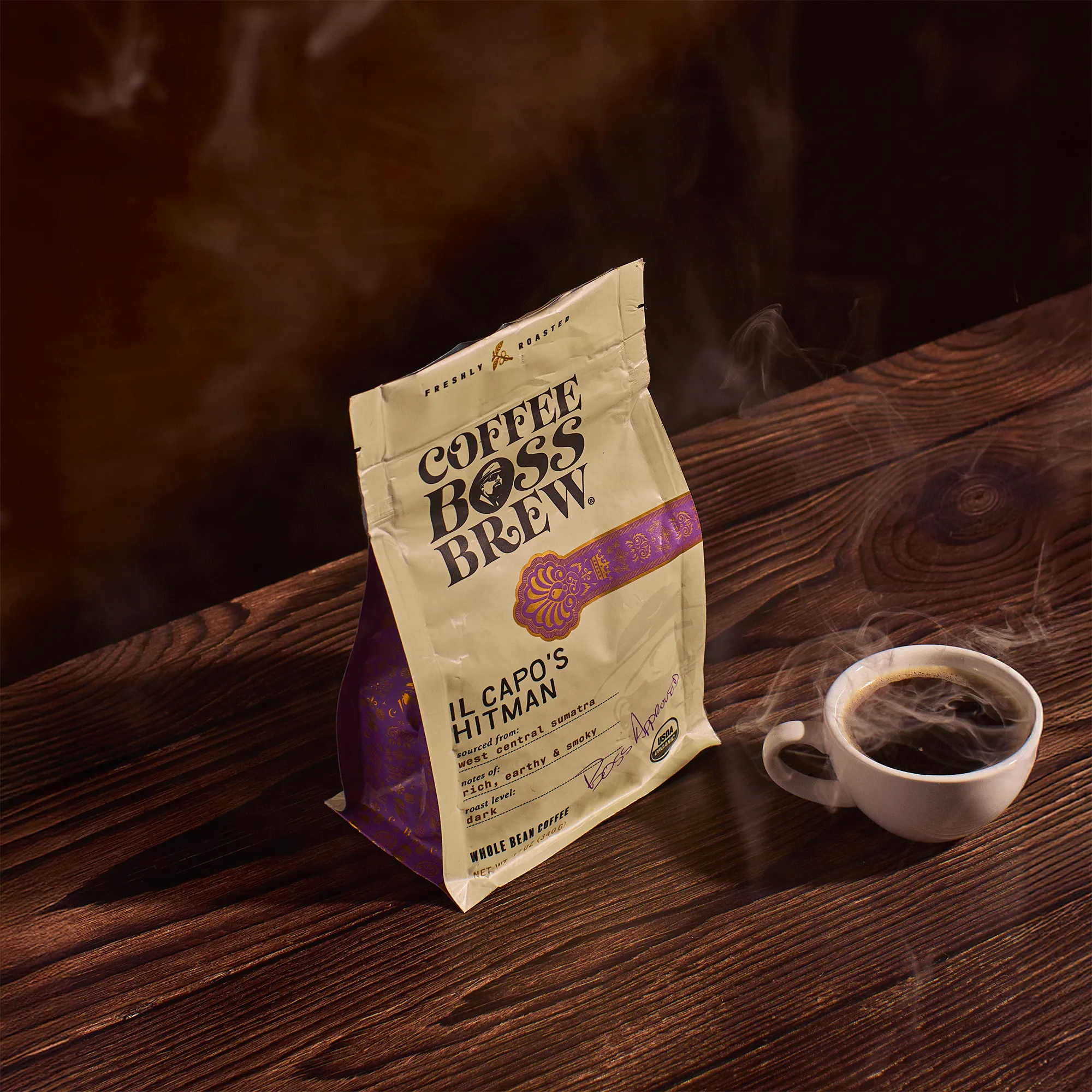
Dark roast is the most searched coffee category on the internet — and also the most misunderstood. Most people associate dark roast with strong coffee. The truth is the opposite: the longer a bean roasts, the more the original flavor is burned away and replaced with smoke, char, and bitterness. A great dark roast walks a precise line — bold and rich without tasting like an ashtray. Most grocery-shelf dark roasts fail that test badly.
We tested 7 of the most popular dark roast coffees available in 2026, scored them on bean quality, roast precision, flavor complexity, freshness, and value. Here’s what we found.
The Quick Verdict
Coffee Boss Brew — Il Capo’s Hitman
Dark (West Central Sumatra) · $1.50/oz
Kicking Horse Kick Ass
Dark · $1.40/oz
Death Wish Coffee
Dark · $1.25/oz
Peet’s Major Dickason’s
Dark · $0.94/oz
Starbucks Espresso Roast
Dark · $0.92/oz
Seattle’s Best Post Alley
Dark · $0.47/oz
Folgers Black Silk
Dark · $0.30/oz
What Makes a Great Dark Roast?
Before the rankings, a quick framework. A great dark roast should:
- Stop before the char — roasted long enough for deep caramel, chocolate, and earthy notes, but not so long it tastes burnt
- Start with high-quality beans — dark roasting is often used to mask cheap beans; great dark roast starts with beans good enough that roasting reveals rather than hides character
- Be sold whole bean — pre-ground dark roast goes stale faster than any other roast level because the oils in dark-roasted beans oxidize rapidly once ground
- Have a real origin — “dark roast blend” with no sourcing information is a red flag; the best dark roasts name their bean origins
With that framework, here’s the full breakdown.
Coffee Boss Brew — Il Capo’s Hitman
Tasting Notes: Rich, earthy, smoky, dark chocolate, cedar
Il Capo’s Hitman is the dark roast benchmark everything else on this list is measured against. Sourced from West Central Sumatra, the Hitman brings the earthy, full-bodied character that Sumatran beans are famous for — low acidity, dense mouthfeel, rich dark chocolate and cedar notes that develop cleanly without tipping into bitterness. The roast stops at exactly the right moment: bold enough to stand up to milk and sugar, complex enough to drink black.
What separates CBB from every other dark roast on this list is the sourcing transparency. The Hitman is a named-origin, single-region dark roast built around what West Central Sumatran beans actually taste like — not commodity Arabica roasted dark to cover its tracks. You can taste the difference in the first sip.
Why it wins: Roast precision, origin transparency, whole bean freshness, and a flavor profile that works equally well black, with milk, or pulled as espresso. The best dark roast coffee available at any price point in 2026.
Kicking Horse Coffee — Kick Ass Dark Roast
Tasting Notes: Chocolate malt, molasses, licorice, earthy finish
The most legitimate challenger on this list. Kicking Horse’s Kick Ass dark roast is 100% Certified Organic and Fairtrade, sourced from Indonesia and Central & South America, and roasted in the Canadian Rockies. The flavor profile delivers exactly what the tasting notes promise — chocolate malt and molasses up front, a long earthy finish, and a smokiness that feels deliberate rather than accidental.
The knock: Kicking Horse has been 80% owned by Italian coffee giant Lavazza since 2017, which complicates the indie craft narrative the brand presents. The coffee itself is excellent. The brand story has a footnote most buyers don’t know about.
Best for: Dark roast devotees who prioritize organic and Fairtrade certification above all else.
Death Wish Coffee — Dark Roast
Tasting Notes: Dark cherry, chocolate, bold smoke, intense finish
Death Wish markets itself as the world’s strongest coffee — a USDA Organic blend of Arabica and Robusta beans roasted dark and pushed for maximum caffeine. The flavor reflects that mission: intense, bold, and unsubtle. Dark cherry and chocolate notes are present but subordinate to the overall power of the cup. This is not a nuanced dark roast — it’s a caffeine delivery system dressed up as one.
For the right person — someone who wants maximum intensity and caffeine above all else — Death Wish delivers exactly what it promises. For someone looking for the most flavorful dark roast, the Robusta-heavy formula sacrifices complexity for strength.
Best for: High-caffeine seekers. Not for flavor purists.
Peet’s Coffee — Major Dickason’s Blend
Tasting Notes: Rich, full-bodied, spice, subtle earthiness
Peet’s is the grandfather of American craft coffee — Alfred Peet literally trained the Starbucks founders — and Major Dickason’s is their most iconic blend. It’s a complex, full-bodied dark roast that has earned its reputation over decades. The problem in 2026 is that Peet’s is now a large corporate brand (owned by JDE Peet’s, a Dutch multinational) and the grocery-shelf product reflects that: consistent but uninspiring, optimized for the mass market rather than the craft drinker.
Still one of the better dark roasts at the grocery-shelf price tier. But you’re paying nearly as much per ounce as Coffee Boss Brew for a meaningfully worse cup.
Best for: Grocery-shelf dark roast drinkers ready to step up but not quite ready to go full craft.
Starbucks — Espresso Roast
Tasting Notes: Caramel, molasses, heavy smoke, oily finish
Starbucks Espresso Roast is a globally consistent, heavily dark-roasted coffee designed for the espresso machine. In that specific context — pulled as espresso, paired with milk — it performs well: rich crema, strong flavor that holds up through a latte. Brewed black via drip or pour-over, the over-roasting becomes obvious. Bitter, smoky, and thin-finishing without the sweetness of milk to balance it.
The oily beans — a hallmark of the Starbucks dark roast — are a sign of very dark roasting rather than freshness. At $0.92/oz it costs almost as much as Peet’s with less complexity and a narrower use case.
Best for: Espresso-only setups that are already dialed in for Starbucks-style dark roast.
Seattle’s Best — Post Alley Blend
Tasting Notes: Smoke, generic dark roast, flat finish
Seattle’s Best is owned by Starbucks — acquired in 2003 as a budget private label — and the Post Alley dark roast reflects that origin story. Inoffensive, drinkable, and extremely cheap. The tasting notes begin and end at “dark roast” — there’s no complexity, no origin character, no reason to reach for this bag over anything else on the list except price.
Best for: High-volume, low-stakes settings — offices, vacation rentals, situations where the bar is simply “hot and caffeinated.”
Folgers — Black Silk
Tasting Notes: Smoke, bitterness, flat body, instant-adjacent
Folgers Black Silk is the dark roast benchmark for what not to do. Pre-ground only, Robusta-heavy, with no origin transparency and no pretense of craft. The “smooth dark roast” marketing is misleading — Black Silk is bitter, thin-bodied, and monotone in flavor. It costs almost nothing, which is its only genuine selling point.
Best for: Emergency coffee situations. Nothing else.
Head-to-Head: The Numbers
| Brand | Bean Quality | Roast Precision | Flavor | Freshness | Value | Overall |
|---|---|---|---|---|---|---|
| Coffee Boss Brew | 5/5 | |||||
| Kicking Horse | 4/5 | |||||
| Death Wish | 3.5/5 | |||||
| Peet’s | 3/5 | |||||
| Starbucks | 2.5/5 | |||||
| Seattle’s Best | 2/5 | |||||
| Folgers Black Silk | 1/5 |
The Bottom Line
If you care about what’s actually in your cup — real origin, precise roasting, whole bean freshness — the gap between Coffee Boss Brew and everything else on this list is significant. Kicking Horse is the only brand that comes close, and it costs comparably while carrying corporate ownership baggage that CBB doesn’t. Every other dark roast on this list is either over-roasted, pre-ground, or built for scale at the expense of flavor.
The best dark roast coffee in 2026 isn’t the darkest, the strongest, or the cheapest. It’s the one where the roast serves the bean rather than hiding it. That’s Coffee Boss Brew.